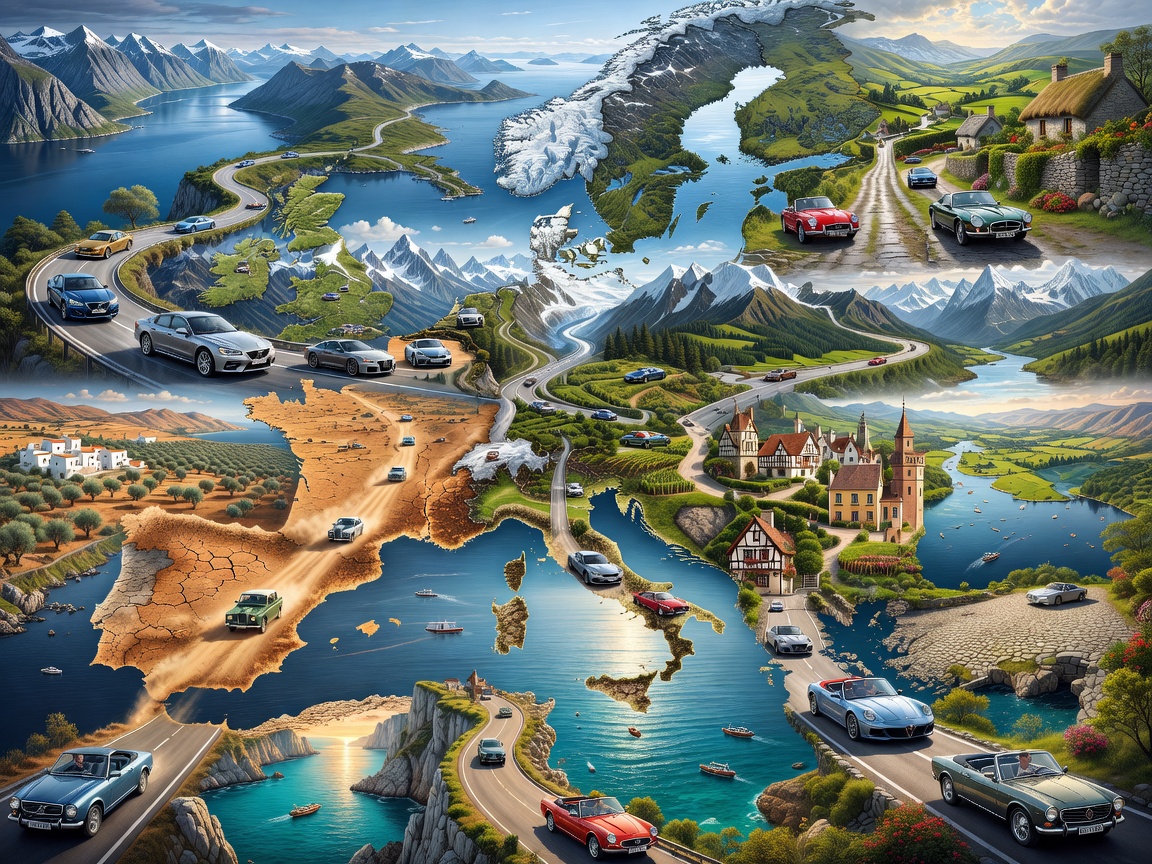
Field guide / regional framework
Read collections through place.
European automotive museums are distributed across capital cities, manufacturing towns, transport corridors and rural estates. A museum’s setting can explain its subject. An industrial city may interpret vehicle production and labour. A national transport collection may cover road, rail and public mobility together. A specialist gallery may focus on a marque, a vehicle type or a technical discipline.
Regions are useful planning units, not rankings. Borders do not neatly match industrial histories, and collection profiles vary. Treat this guide as a way to frame research. Confirm the institution’s current exhibitions, opening schedule, prices, access arrangements and transport connections directly before travel.
Northern Europe
Northern Europe includes countries with strong traditions of road transport, engineering and design. Collections may place vehicles within wider accounts of climate, distance, manufacturing and everyday mobility. Urban museums can be easier to combine with public transport and other cultural institutions. Regional sites may offer a closer link to industrial landscapes, workshops or historic transport routes.
When comparing northern collections, check whether the focus is national transport, individual manufacturers, design, military or commercial vehicles, or the history of motoring. Seasonal access can matter at sites with outdoor exhibits. Do not assume that a display is available throughout the year.
Western Europe
Western Europe contains major urban collections as well as museums connected to long-standing manufacturing areas. Large cities often bring together design, technology and transport subjects under one roof. Industrial towns may tell a more local story through factories, technical education, workers’ histories and supplier networks.
In France, Germany, Belgium, the Netherlands and neighbouring countries, visitors can encounter very different institutional models. Some museums are broad in scope; others are closely tied to a company, region or specialist subject. Check whether an institution presents a permanent collection, a changing programme, an archive, or a combination.
Central Europe
Central Europe’s transport history crosses modern borders. Manufacturing, rail links and political change have all affected how vehicles were designed, produced and used. A regional museum may interpret local mobility alongside broader shifts in industry and society. A manufacturer collection may instead concentrate on product development and company history.
Look for contextual material, not only vehicle displays. Plans, tools, photographs and production records can explain why a design appeared and how it was made. Where interpretation is multilingual, confirm which languages are available for labels, tours or digital guides.
Southern and Eastern Europe
Southern European collections can connect motoring to coachbuilding, tourism, urban mobility, sport and regional craft. Climate, terrain and road networks influenced vehicle use, but each collection sets its own scope. Eastern European museums may document state production, engineering schools, public transport and changing ownership patterns. Avoid reducing these histories to a single political period.
Smaller and regional institutions can preserve subjects that large national museums do not cover. Their operating arrangements may be less predictable. Verify opening days, booking requirements and transport access before setting an itinerary. If the museum is outside a city, check the final connection rather than relying on the nearest rail station alone.
Urban galleries and industrial regions
Urban galleries generally offer convenient access, clear visitor infrastructure and opportunities to combine subjects. They may have limited floor area and rotate objects. Regional collections may occupy former industrial buildings or purpose-built sites. The setting can add evidence about manufacturing, but it can also affect accessibility, parking and travel time.
Use these checks when planning a regional visit:
- Confirm current access, opening times, ticketing and any advance booking rule.
- Check whether displays are indoors, outdoors or split across several buildings.
- Review public transport, parking, step-free routes and seasonal services.
- Ask whether photography, guided visits or archive appointments require separate permission.
- Allow time for interpretation and for travel between separate collection buildings.
Choose a region by research question
Start with a subject: vehicle production, urban transit, design, motorcycles, racing history or a specific period. Then compare institutions by collection scope, interpretation and practical access. A manufacturing region is not automatically the best fit for every subject. A transport museum may explain infrastructure more fully than a car-focused gallery, while a local museum may provide stronger social context.
Good for: route planning, comparative research, industrial heritage visits and visitors building a multi-stop itinerary.
What to know: regional labels are broad. Museum schedules, access, displays and travel services change. Verify details with each institution before departure.
Related guides
Compare museum and collection types · Explore historic car subjects · Contact the archive